Angioplasty is one of the most frequently performed cardiac procedures in India, and one of the most frequently misunderstood — usually in the same direction. It is thought of as a repair, after which the heart problem has been dealt with. It is more accurate to think of it as relieving one obstruction in one place, in a disease that is present throughout the arterial tree and continues afterwards. That distinction is the whole reason this article exists.
What the underlying problem is
The heart muscle is supplied by coronary arteries running across its surface. Over years, fatty plaque accumulates within the wall of those arteries. A narrowing limits flow, and when the muscle beyond it needs more blood than the narrowing allows — on exertion, typically — the result is angina. If a plaque ruptures, the body responds as it would to any injured vessel wall, forming a clot. A clot that blocks the artery completely stops the blood supply, and the muscle it fed begins to die. That is a heart attack.
What angioplasty is, step by step
The full name is percutaneous coronary intervention, PCI. It is done through a puncture in an artery, usually at the wrist, sometimes at the groin, under local anaesthetic. You are awake throughout. There is no cut in the chest, and it is not open-heart surgery.
- Local anaesthetic is injected at the wrist. This stings for a few seconds and is generally the most uncomfortable part of the procedure.
- A short tube is placed in the radial artery, and a fine catheter is passed through the arterial system to the origin of the coronary arteries. Arteries have no pain-sensing nerves in the way skin does, so this is not felt.
- Contrast dye is injected and X-ray images are taken. This is the angiogram — the map. Many people feel a brief warm flush as the dye goes in.
- If a significant narrowing is found and is suitable for treatment, a very fine wire is passed across it, and a balloon is passed over the wire and inflated to open the vessel. The inflation lasts seconds and can produce a brief episode of the same chest discomfort the narrowing was causing, because flow is momentarily interrupted.
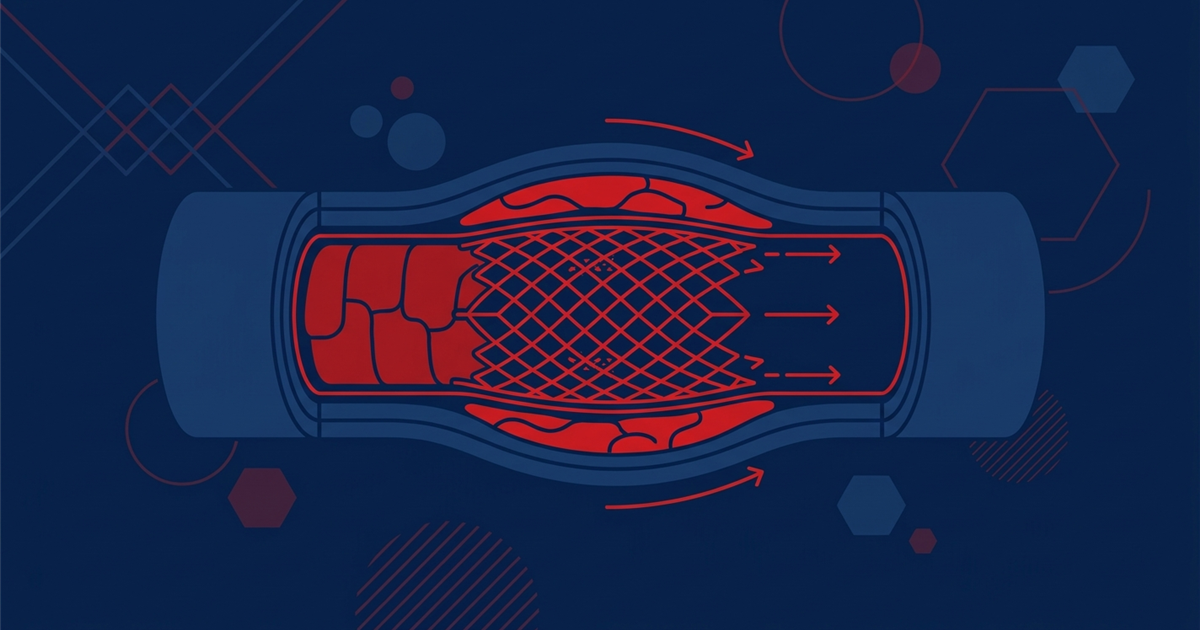
- A stent — a small mesh tube, expanded by the balloon — is deployed to hold the artery open. Nearly all stents used today are drug-eluting: coated with a medication that is released slowly into the vessel wall to reduce the tendency of scar tissue to re-narrow the segment.
- The catheter and wire are removed. The wrist is compressed with a band for a few hours. Most people are watched overnight and go home the following day.
In an acute heart attack the same procedure is done urgently, to reopen the blocked artery, and its value depends heavily on how quickly it is done. This is the entire reason chest pain suggestive of a heart attack is an ambulance call and not an appointment. Muscle that has died does not come back.
What a stent does
A stent props open one segment of one artery. In doing so it restores blood flow through that segment. Where the narrowing was causing angina, that discomfort typically improves, and exercise tolerance improves with it. Where the artery was acutely blocked, opening it early limits the amount of heart muscle lost. Those are real and substantial benefits, and they are the reason the procedure is done.
What a stent does not do
This is the part that is most often not heard clearly on the day of discharge, when a great deal is being said at once.
- It does not cure coronary artery disease. The disease is a process in the wall of the arteries throughout the body. A stent treats a location, not the process.
- It does not treat the other plaques. A stented artery may have several other narrowings that were not severe enough to need treatment, and other arteries have their own.
- It does not remove the reason the plaque formed. Diabetes, blood pressure, cholesterol, smoking and inactivity continue to act on every artery after the procedure exactly as they did before it.
- It does not make the affected segment maintenance-free. A stented segment can narrow again through scar tissue growth, and — far more dangerously — can clot suddenly if the antiplatelet medication is stopped early.
- It does not restore heart muscle already lost to a previous heart attack.
Afterwards: why the medication is the point
A newly placed stent is a metal surface inside an artery. Until the body's own vessel lining grows over it, which takes months, that surface is a site where a clot can form. The medication prescribed after the procedure is what prevents that. Stent thrombosis — a sudden clot in a stent — presents as a heart attack, often a severe one, and the commonest identifiable reason for it is antiplatelet medication being stopped early.
Two antiplatelet medications are usually given together for a defined period, followed by one continued long term, together with a statin and whatever is needed for blood pressure, diabetes and heart function. The duration is decided individually, and it depends on the type of stent, how many were placed, what the arteries looked like, and the person's own bleeding risk. It is not a number that can be looked up.
The rules that follow from this are simple and important. Do not stop, skip or ration these tablets for any reason without speaking to your cardiologist. Do not let another doctor, dentist or surgeon stop them for a procedure without that decision being discussed with the cardiologist who placed the stent — that conversation happens routinely and safely, but it has to happen. If a prescription is running out, get it renewed before it does, not after. And tell any doctor treating you that you have a stent, along with the date it was placed and, where you have it, the card giving its details.
The rest of it
Cardiac rehabilitation — a structured, supervised programme of exercise and education — has good evidence behind it and is under-used in India. Where it is available, it is worth taking seriously. Where it is not, the exercise plan is agreed at follow-up rather than improvised.
Recovery from the procedure itself is quick. Most people are back to routine activity within a week, with the wrist site kept dry and the arm spared heavy lifting for a few days. Driving, air travel, returning to work and resuming sexual activity all have straightforward answers, and they depend on how much heart muscle was affected, so they are asked and answered at the follow-up appointment rather than assumed.
Stopping tobacco in every form is the single change with the largest effect on what happens next. Blood pressure, LDL cholesterol and diabetes are managed to targets that are set lower after a coronary event than before it. Follow-up appointments continue after the symptoms have gone, because the purpose of them is the arteries that were not stented.
Chest pain after a stent
Some chest discomfort in the days after the procedure is common and is often related to the procedure itself rather than the heart. But new chest pain resembling the original symptom, particularly if it comes on at rest or does not settle, must be treated as an emergency and not as something to be discussed at the next appointment. The presence of a stent does not make chest pain less serious. In someone with a recent stent it makes it more so.
Call 108 or go directly to the nearest emergency department. Do not drive yourself, and tell the emergency team that you have a coronary stent and when it was placed.
This article is general education about a condition or a test. It is not medical advice about you, it does not create a doctor and patient relationship, and it is not a substitute for consultation with a qualified doctor who has examined you.